
Recap: Policy, Principles, and Property Taxes: District 4 GOP Candidates in Clark Forum (Podcast/Video)


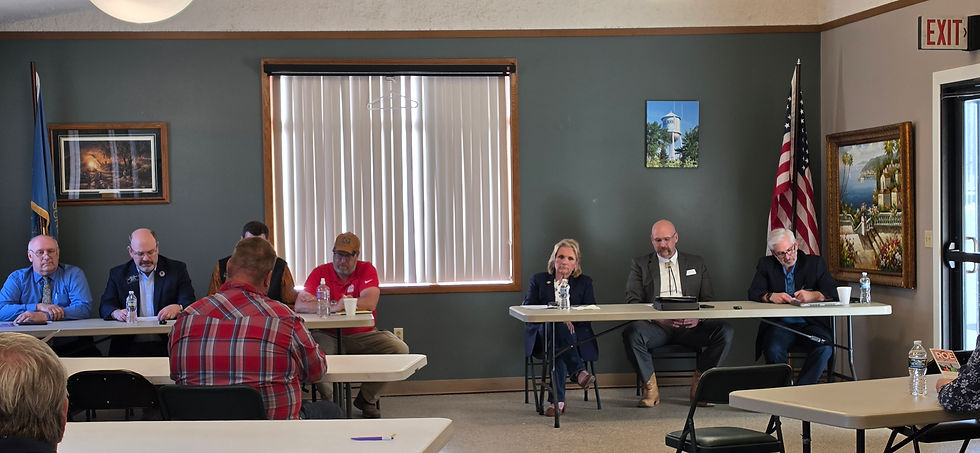
Northeast Radio SD News – Clark, SD - With the June 2nd primary election approaching, Republican candidates for South Dakota’s District 4 House and Senate seats gathered in Clark on Thursday night for a spirited forum. Moderated by Lana Greenfield and Terry Schlagel, the event asked candidates to define their visions for rural healthcare, state spending, and the future of conservative leadership in Pierre.
Healthcare and Infrastructure: The Rural Survival Gap
The Senate portion of the evening opened with a question about the survival of struggling volunteer ambulance and EMT services in small communities.
Tim Begalka, a greenhouse owner from Clear Lake, emphasized local control and volunteerism.
“Part of that responsibility lies within the individual people within a community, because a lot of these are volunteer... I would just hope that would be a priority of their spending priority of whatever level the money is available from”.
Senator Stephanie Sauder pointed to the $400 million Rural Health Transformation Program as a critical lifeline.
“South Dakota accepted the $400 million over five years. It helps funding for our ambulances, our rural health of any sort... We’ve established new liability protections for nurses on ambulances so they can... allow more people to be able to work”.
Regarding the future of the state’s aging prison structure once a new facility is built, Sauder expressed fiscal caution.
“I don’t know if we want a museum that big. I think it would be too costly... It depends on how much it’s going to cost the state to repair it or take it down”.
Begalka countered with a proposal for rehabilitation services.
“I would like to see the state use it for some type of program, whether it be youth... maybe there is a way for us to use it for a facility for rehabilitation”.
Pipelines and Data Privacy: The Global vs. Local Tug-of-War
The debate grew heated over international business interests and new technology.
On the topic of carbon pipelines, Begalka remained a staunch opponent.
“As far as the summit pipeline and a CO2 pipeline, I would say absolutely not. That was, it’s useless, it’s meaningless, it’s actually detrimental to the environment”.
Senator Sauder focused on the inevitability of Artificial Intelligence and the need for domestic data storage.
“AI is here to stay, whether we like it or not... we need to know how to handle that and to have it in our state... by staying in the United States, we can get more of that cybersecurity... if it leaves our country, we have no idea what that cybersecurity is”.
The House Debate: Property Taxes and Budget Growth
The five House candidates faced a barrage of questions regarding the 50% increase in the state budget over the last eight years and the persistent burden of property taxes.
Ryan Kohl, the only full-time farmer in the race, called for a growth-based solution.
“Property taxes are always on people’s minds... but this [current measure] does nothing for [renters]. We really need some more growth, some more housing. We need to expand what we can tax, and that’ll bring down the property taxes for everybody”.
Dylan Jordan offered a more radical critique, questioning the tax's constitutionality.
“My personal opinion is property taxes are unconstitutional, so we need to work on abolishing them... In order to address property taxes fully, we have to address the spending on all levels”.
Kent Roe pushed back on recent relief measures, calling them incomplete.
“I thought it was kind of a half-baked idea... It’s clearly a tax shift. To Ryan’s point, it ignores tenants completely. It doesn’t provide any funding for the big three... your state employees, your schools, and your special care providers”.
Fred Deutsch advocated for a return to specific agricultural protections.
“I’d like to bring back the ag circuit breaker... I’d like to also look at shifting some local efforts that we use to pay our schools... why can’t we put more of that tax burden on the state to pay for”.
Gary Hudiburgh suggested looking to innovative technology for budget efficiency.
“It’s a marketplace of ideas... find the folks that are doing government the best... and then be able to share that information... the free flow of information... is the way that I’d be looking at addressing that [spending]”.
Scorecards and Scrutiny: Pinpoint Challenges
Individual voting records and backgrounds were also placed under the microscope.
Dylan Jordan defended a controversial “nay” vote on funding for the Richmond Dam.
“I don’t see why we had to vote to give them the extra money this year when we could have followed through on the proper procedure next year... it was one of three people in both chambers... that voted no”.
Kent Roe addressed his scores from advocacy groups like South Dakota Right to Life.
“I don’t find any value in most scorecards... I’ve been pro-life my whole life. I’ve... been pretty offended by some of the pro-life people that want to create felonies for people who are in tough luck” .
Fred Deutsch explained his opposition to House Bill 1212, which sought to criminalize women for abortions.
“This bill... would put women in jail for life or expose them to the death penalty for having an abortion. I just cannot buy that... Putting women in jail, your 19-year-old girl gets raped, and you’re going to threaten her with jail. I’m sorry. This is not the kind of South Dakota I want”.
Gary Hudiburgh addressed his participation in the Billy Sutton Leadership Institute, a program founded by a former Democratic candidate.
“That’s a nonpartisan leadership institute... It’s a matter of being able to go and network across the state of South Dakota... I gained the network, the capability, and frankly, the confidence to be able to go have discussions with tribal nations”.
Closing Visions: Decorum and The Next Generation
The forum concluded with a reflection on the lack of civility in the state capitol.
Deutsch called for statesmanship.
“I look forward to a return of civility and statesmanship in the state capitol. We should be examples to our children... instead of saying, don’t trust government, we say, what an honor it is to serve in this magnificent building”.
Ryan Kohl closed by tying his candidacy to the future of his own children.
“If you elect me, my number one priority is going to be to make sure our kids have a strong future in South Dakota... I want it to be a hard decision if they choose to leave”.
Early voting for the District 4 primary is available now, leading up to the election on June 2nd.


